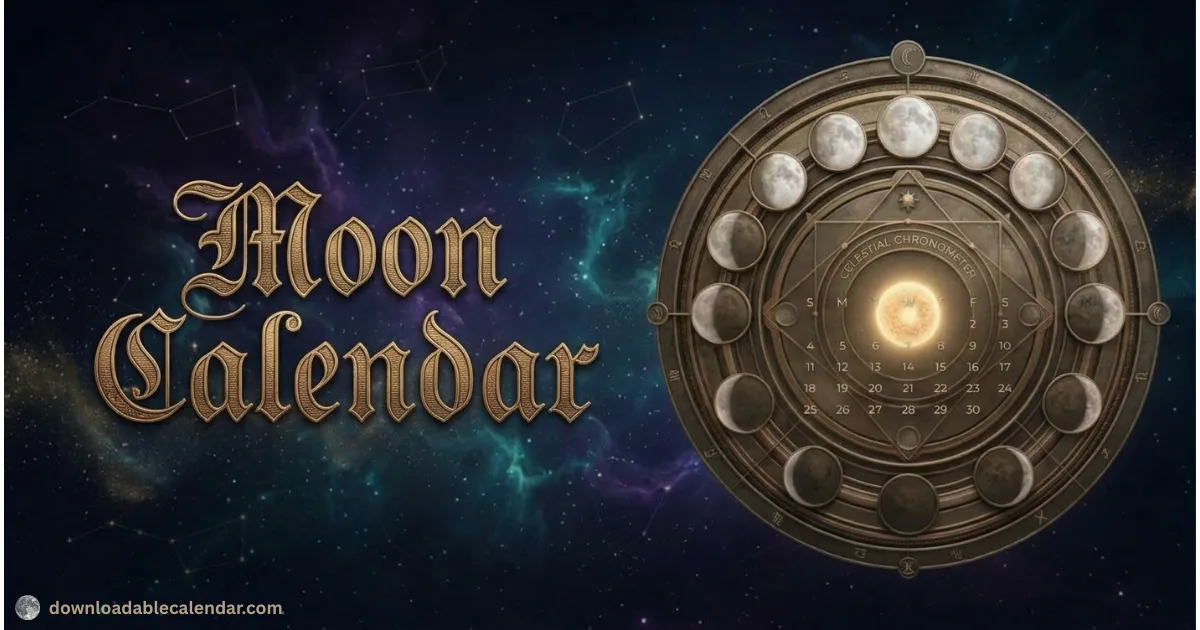
Explore the Moon’s changing shape with our interactive moon calendar. View daily phases, find full moon and new moon dates, and switch between monthly and yearly calendars. Choose your city, adjust the display, and download a printable calendar in PDF, Word or Excel.
October 2026
1 October 2026
Waning Gibbous
75.2% illuminated · 20.1 days old
SELECTED DAY · LOCAL NOON2 October 2026
Waning Gibbous
64.7% illuminated · 21.1 days old
SELECTED DAY · LOCAL NOON3 October 2026
Waning Gibbous
53.4% illuminated · 22.1 days old
Last Quarter · 18:54 IST
SELECTED DAY · LOCAL NOON4 October 2026
Waning Crescent
42.0% illuminated · 23.1 days old
SELECTED DAY · LOCAL NOON5 October 2026
Waning Crescent
31.1% illuminated · 24.1 days old
SELECTED DAY · LOCAL NOON6 October 2026
Waning Crescent
21.2% illuminated · 25.1 days old
SELECTED DAY · LOCAL NOON7 October 2026
Waning Crescent
12.9% illuminated · 26.1 days old
SELECTED DAY · LOCAL NOON8 October 2026
Waning Crescent
6.5% illuminated · 27.1 days old
SELECTED DAY · LOCAL NOON9 October 2026
Waning Crescent
2.2% illuminated · 28.1 days old
SELECTED DAY · LOCAL NOON10 October 2026
Waning Crescent
0.3% illuminated · 29.1 days old
New Moon · 21:19 IST
SELECTED DAY · LOCAL NOON11 October 2026
Waxing Crescent
0.5% illuminated · 0.6 days old
SELECTED DAY · LOCAL NOON12 October 2026
Waxing Crescent
2.9% illuminated · 1.6 days old
SELECTED DAY · LOCAL NOON13 October 2026
Waxing Crescent
7.2% illuminated · 2.6 days old
SELECTED DAY · LOCAL NOON14 October 2026
Waxing Crescent
13.0% illuminated · 3.6 days old
SELECTED DAY · LOCAL NOON15 October 2026
Waxing Crescent
20.1% illuminated · 4.6 days old
SELECTED DAY · LOCAL NOON16 October 2026
Waxing Crescent
28.2% illuminated · 5.6 days old
SELECTED DAY · LOCAL NOON17 October 2026
Waxing Crescent
37.0% illuminated · 6.6 days old
SELECTED DAY · LOCAL NOON18 October 2026
Waxing Crescent
46.3% illuminated · 7.6 days old
First Quarter · 21:42 IST
SELECTED DAY · LOCAL NOON19 October 2026
Waxing Gibbous
55.8% illuminated · 8.6 days old
SELECTED DAY · LOCAL NOON20 October 2026
Waxing Gibbous
65.2% illuminated · 9.6 days old
SELECTED DAY · LOCAL NOON21 October 2026
Waxing Gibbous
74.3% illuminated · 10.6 days old
SELECTED DAY · LOCAL NOON22 October 2026
Waxing Gibbous
82.6% illuminated · 11.6 days old
SELECTED DAY · LOCAL NOON23 October 2026
Waxing Gibbous
89.8% illuminated · 12.6 days old
SELECTED DAY · LOCAL NOON24 October 2026
Waxing Gibbous
95.3% illuminated · 13.6 days old
SELECTED DAY · LOCAL NOON25 October 2026
Waxing Gibbous
98.8% illuminated · 14.6 days old
SELECTED DAY · LOCAL NOON26 October 2026
Full Moon
99.8% illuminated · 15.6 days old
Full Moon · 09:41 IST
SELECTED DAY · LOCAL NOON27 October 2026
Waning Gibbous
98.2% illuminated · 16.6 days old
SELECTED DAY · LOCAL NOON28 October 2026
Waning Gibbous
93.8% illuminated · 17.6 days old
SELECTED DAY · LOCAL NOON29 October 2026
Waning Gibbous
87.0% illuminated · 18.6 days old
SELECTED DAY · LOCAL NOON30 October 2026
Waning Gibbous
78.1% illuminated · 19.6 days old
SELECTED DAY · LOCAL NOON31 October 2026
Waning Gibbous
67.8% illuminated · 20.6 days old
Major phase moments
2026 at a glance
Major moon phases, by local date
How to use the moon calendar
Start with the month you want to explore, or choose the yearly view to see the bigger picture.
- Choose your city. Enter a city, state or country in the search box, then select the matching city from the suggestions. Check the state and country when several places share a name.
- Select a month and year. Use the selectors and navigation arrows to browse the available dates. Switch to the yearly view to compare all twelve months.
- Make it yours. Choose a Sunday or Monday week start and use the display options to adjust phase labels, highlighted dates and space for notes.
- Save your calendar. Print it, save a PDF, download an editable Word or Excel file, or create a calendar wallpaper for your desktop.
Click a date to see its selected-day details. For the current phase and local viewing times, visit Moon Phase Today.
Reading your moon phase calendar
Each date shows a Moon image and an illumination percentage. The image gives a quick view of its shape; the percentage describes how much of the visible lunar disk is sunlit.
The four principal phases are New Moon, First Quarter, Full Moon and Last Quarter. These mark key points in the lunar cycle. Between them, the Moon passes through crescent and gibbous phases. “Waxing” means the illuminated portion is growing; “waning” means it is shrinking.
Use the highlighted dates and their color key to find the principal phases quickly. The monthly view helps you follow day-to-day changes, while the yearly view makes it easier to compare dates across the year.
Understanding the Lunar Cycle
The moon doesn’t produce its own light; it reflects the sun. As the moon orbits Earth, the amount of sunlight hitting its surface changes, creating the different lunar cycle moon phases. A complete lunar cycle takes about 29.5 days to finish. If you are following a current moon calendar, you will see these main lunar cycle phases unfold:
- New Moon: The moon is between the Earth and the Sun, making it virtually invisible from our viewpoint.
- Waxing Crescent to Waxing Gibbous: The illuminated portion of the moon grows larger each night.
- Full Moon: The Earth sits right between the Sun and the Moon, giving us a fully illuminated, bright lunar disk.
- Waning Gibbous to Waning Crescent: The illuminated portion shrinks back down until it disappears into the next New Moon.
Download a printable moon calendar
The monthly print layout uses a landscape page. The yearly layout brings all twelve months together on one portrait page. Before printing, check the preview and use the matching orientation. If you use US Letter paper instead of A4, choose a fit-to-page setting to keep the edges inside the printable area.
Plan observations and keep a moon journal
A calendar makes it easy to choose a few dates to look outside and compare what you see. Note the Moon’s shape, the time of your observation and whether clouds affected the view. Repeating this over several weeks helps you spot patterns that are easy to miss from a single night’s observation.
You can also use the calendar to plan a classroom activity, mark a full moon evening or keep a record of photographs. Check local moonrise and moonset times on the Today page before making viewing plans. A phase date alone does not tell you when the Moon will be above your horizon.
Moon Calendar – FAQ
Ans: A principal phase happens at one instant, but its local date depends on the time zone. An event late at night in one country can fall on the following morning in another. Select the correct city before comparing calendars, and check whether another source uses local time or UTC.
Ans: The cycle from one new moon to the next averages about 29.5 days. It does not fit neatly into most calendar months, so the principal phase dates shift from month to month.
Ans: Open Moon Phase Today for the current phase, illumination, local moonrise and moonset times, and the seven-day outlook.